Table of Contents
When you think about wide-format printing, construction plans, blueprints, and architectural drawings may be the first things that come to mind.
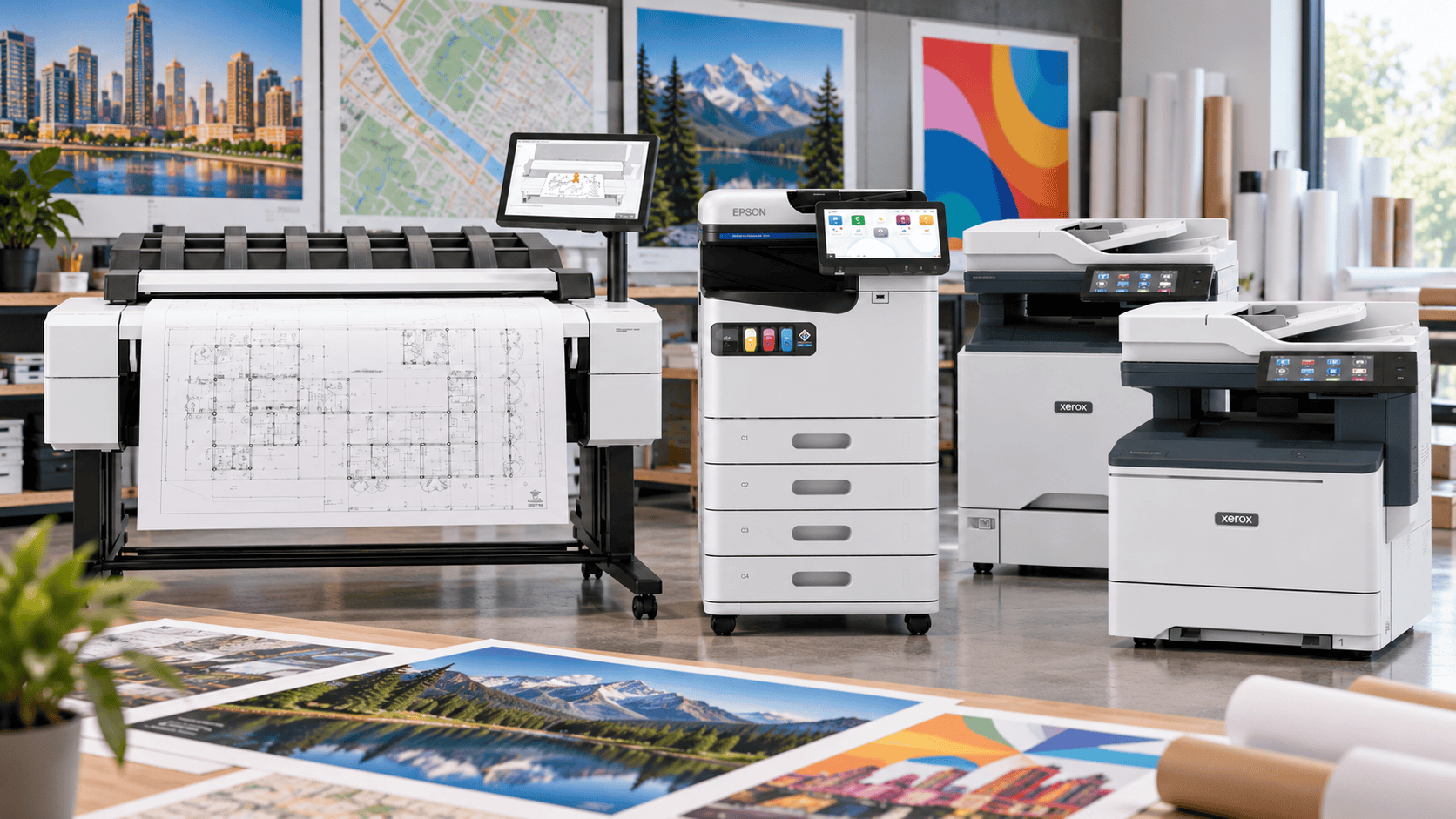
While technical drawings remain an important use for wide-format equipment, today’s printers can do much more. Depending on the printer, ink technology, and media capabilities, wide-format printing can be used for presentation boards, posters, signage, maps, educational materials, photography, and other large-scale graphics.
For businesses, schools, municipalities, architects, engineers, and creative professionals, understanding these possibilities can help you get more value from your current equipment. It can also help you determine whether bringing additional wide-format printing in-house makes sense.
Here are seven ways organizations can use wide-format printers beyond traditional blueprints.
1. Presentation Boards and Project Displays
Architectural and engineering firms frequently need more than construction documents. They may also need polished presentation materials that communicate the vision behind a project.
Wide-format printing can be used to produce:
- Architectural renderings
- Site-plan presentations
- Design review boards
- Planning commission displays
- Client presentation graphics
- Competition and proposal boards
Producing these materials in-house can give teams more control over timing, color, revisions, and final presentation quality.
A technical printer may handle drawings exceptionally well, but a graphics-focused printer may be a better choice when a project requires richer color, smoother gradients, or detailed renderings. The right wide-format printing equipment depends on whether your priority is technical precision, visual impact, or a combination of both.
2. Posters and Promotional Graphics
Wide-format printing also gives organizations the ability to create professional posters and promotional graphics for events, announcements, campaigns, and internal communications.
Common applications include:
- Retail promotions
- Event posters
- Lobby displays
- Recruitment materials
- Safety campaigns
- Product announcements
- Community notices
In-house wide-format printing can be especially useful for organizations that regularly update their messaging or need materials on short notice.
Schools, retailers, healthcare organizations, municipalities, and corporate offices can benefit from producing professional-looking graphics without having to outsource every project.
3. Indoor Signs and Wayfinding
Signage is another practical use for wide-format printing.
Not every sign needs to be permanently installed or designed for outdoor exposure. Many organizations regularly need temporary or changeable indoor signs.
Examples include:
- Directional signs
- Event signage
- Meeting-room notices
- Department identification
- Visitor instructions
- Temporary safety signs
- Building directories
The printer and media must be appropriate for the intended application. A basic technical printer may be suitable for short-term paper signs, while more demanding display applications may require different ink, media, mounting, or finishing capabilities.
Before investing in wide-format printing equipment for signage, consider where the finished graphics will be displayed, how long they need to last, and whether they will be exposed to moisture, sunlight, or frequent handling.
4. Maps and GIS Graphics
Maps often contain detailed lines, small labels, color-coded information, and large geographic areas that can be difficult to interpret on a standard office printer.
Wide-format printing makes it easier to produce:
- Zoning maps
- Utility maps
- Emergency planning maps
- Transportation plans
- Campus maps
- Property maps
- Geographic Information System, or GIS, displays
- Public meeting exhibits
Municipalities, utility providers, educational institutions, environmental consultants, engineers, and planning departments can use wide-format printing to communicate complex geographic information more clearly.
For map production, line accuracy and text clarity may be just as important as color. Matching the printer to the level of detail and type of information being presented is essential.
5. Educational and Campus Graphics
Schools, colleges, universities, libraries, and training organizations can find many uses for wide-format printing throughout the year.
Potential applications include:
- Classroom posters
- Campus maps
- Student presentation boards
- Research displays
- Athletic-event signs
- Performing-arts promotions
- Graduation graphics
- Enrollment and orientation materials
- Library exhibits
- Temporary wayfinding
Having wide-format printing capabilities in-house can help staff respond quickly to events, schedule changes, student activities, and new communication needs.
Different departments may also be able to share the equipment, increasing its overall value. Before selecting a printer, schools should consider expected print volume, ease of use, media cost, available space, and who will be responsible for operating the equipment.
6. Photography, Fine Art, and Branded Displays
Graphics-oriented wide-format printers are designed to provide the color, detail, and tonal range required for visually demanding projects.
Depending on the equipment and media, wide-format printing applications may include:
- Professional photography
- Art reproductions
- Gallery displays
- Branded office graphics
- Museum exhibits
- Portfolio pieces
- High-quality marketing displays
These applications require different capabilities than traditional CAD printing. Color accuracy, ink configuration, media compatibility, resolution, and color-management workflow become increasingly important.
A printer that performs well for black-and-white construction drawings is not automatically the best choice for photographic or fine-art output. Organizations producing both technical and graphic work may need a versatile model or separate equipment designed for each workflow.
7. Short-Term Banners and Event Materials
Some wide-format printing equipment can also produce materials for conferences, presentations, community events, open houses, and other temporary displays.
Applications might include:
- Event banners
- Welcome signs
- Sponsor recognition
- Conference graphics
- Open-house displays
- Fundraising-event materials
- Trade-show messaging
The intended use should guide your choice of printer and media. Indoor, short-term displays have different requirements from outdoor banners expected to withstand wind, sunlight, and weather.
Remember that printing is only one part of the process. Trimming, mounting, laminating, and other finishing steps may be needed before a graphic is ready to display.
Choosing the Right Wide-Format Printing Equipment
The best wide-format printer is not necessarily the model with the longest feature list or the fastest advertised speed. It is the one that fits the work your organization produces most often.
Before investing in wide-format printing equipment, consider these questions:
- What types of documents or graphics will you print?
- Do you primarily need line accuracy or photographic color?
- What sizes will you produce most frequently?
- Which media types do you expect to use?
- How many prints will you produce each week?
- Will several departments use the equipment?
- Do you need scanning or copying capabilities?
- How quickly do projects need to be completed?
- Will finished pieces require trimming, mounting, or laminating?
- Do you have the staff and space to support an in-house workflow?
It is also important to consider the complete cost of production. Ink, media, maintenance, labor, finishing, and outsourcing costs should all be part of the comparison.
Should You Bring Wide-Format Printing In-House?
Bringing wide-format printing in-house can make sense when your organization regularly produces large-format materials, faces frequent deadline pressure, or needs greater control over revisions and output.
Potential advantages include:
- Faster turnaround
- Greater control over last-minute changes
- Easier production of small quantities
- Reduced dependence on outside schedules
- More opportunities to use wide-format graphics throughout the organization
Outsourcing may still make more sense for occasional projects, specialized materials, complex finishing, or applications requiring equipment your organization would rarely use.
The right decision depends on your print volume, applications, staff, deadlines, and total production costs.
Explore What Wide-Format Printing Can Do for Your Organization
Wide-format printing is not limited to blueprints.
The right equipment can support technical documentation, presentations, marketing, education, planning, signage, photography, and many other applications.
Bay Plotter helps organizations throughout Northern California evaluate wide-format equipment from HP, Xerox, and Epson. Our team can help you compare printer capabilities, media requirements, workflow needs, and long-term support so you can select equipment suited to the work you actually produce.
Contact Bay Plotter to discuss your wide-format printing needs and explore the right equipment for your organization.